Risk & Analysis
RGA Emerging-Risk Monitoring Practicum
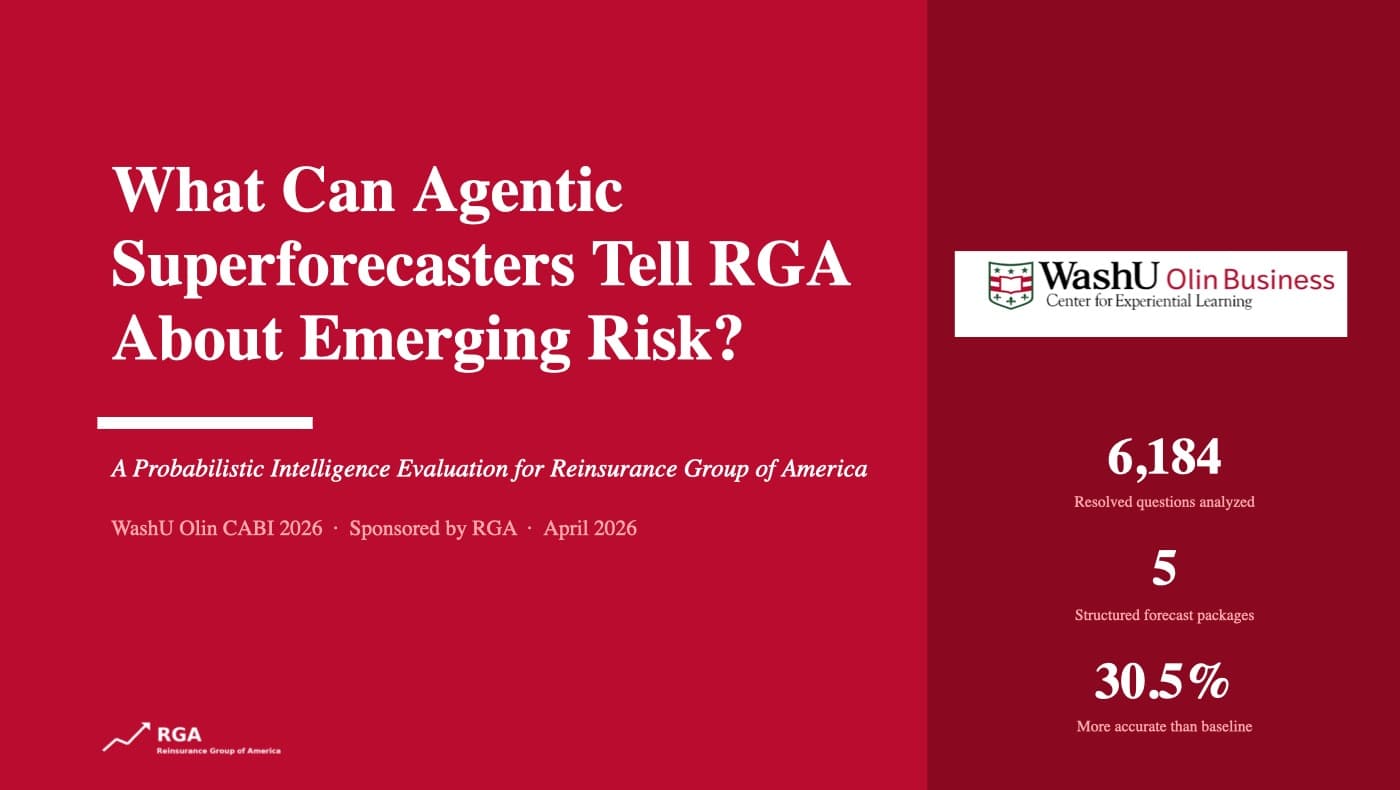
Assessed whether Reinsurance Group of America (RGA) could rely on Metaculus crowd forecasts for forward-looking risk decisions — assembled a dataset of 11,000+ questions, evaluated forecasts across 6,184 resolved questions in Python, showed 30.5% lower forecast error than baseline, and presented an LLM-augmented workflow to senior stakeholders.
The problem
Step-change risks — GLP-1 drugs reshaping longevity, pandemic emergence, AI liability — move faster than historical actuarial data can track. RGA needed a statistically grounded answer to one question: can Metaculus, a crowd probabilistic-forecasting platform, be relied on as a forward-looking signal layer alongside the actuarial engine?
The approach
Assembled a dataset of 11,000+ Metaculus questions and evaluated forecasts across the 6,184 that had resolved — Brier scoring requires known outcomes. Computed Brier score (0.148), Brier Skill Score of 0.305 — a 30.5% reduction in Brier score versus baseline — and expected calibration error (0.070), then ran a Murphy decomposition to separate reliability from resolution. Built a domain-level intelligence map across six insurance-relevant risk domains, five structured forecast packages (GLP-1, H5N1, AI liability, life expectancy, climate & macro), and an LLM-augmented analyst workflow with explicit governance rules and a phased 90-day pilot roadmap.
The outcome
A 24-slide final presentation delivered to senior RGA stakeholders: a platform credibility assessment showing 30.5% lower forecast error than baseline across 6,184 resolved questions, with calibration and reliability analysis; a ranked domain intelligence map; five decision-ready forecast packages; an LLM-augmented analyst workflow; and a sequenced implementation roadmap with go/no-go gates.
Business value
Supports earlier identification of emerging risk signals before they appear in traditional actuarial data — enabling more proactive underwriting decisions in fast-moving risk categories.